
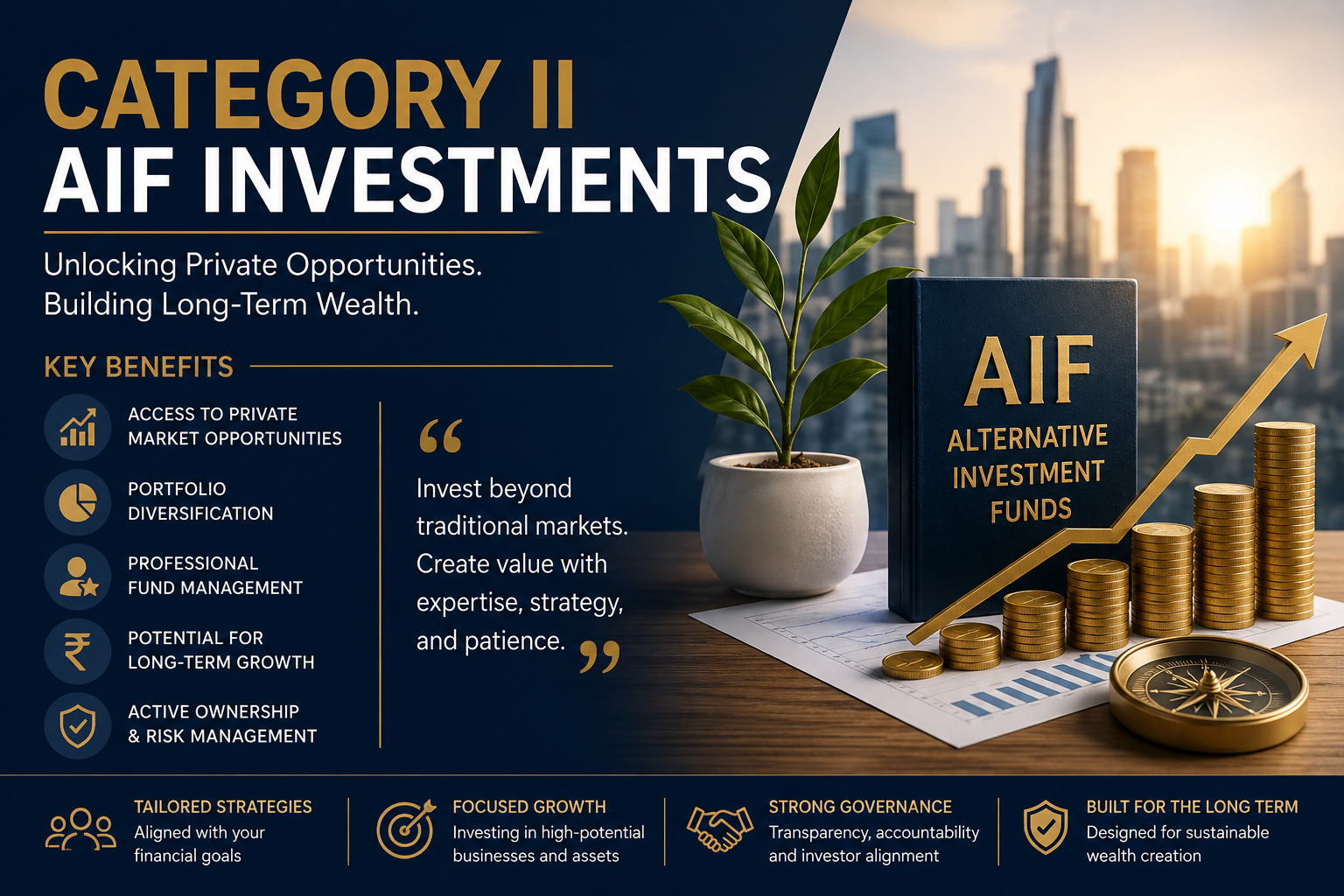
Category II AIF Investments: Benefits for Long-Term Investors
India’s investment landscape has changed sharply over the past decade. Investors who once relied mainly on fixed deposits, listed shares, mutual funds, and property now have access to a broader range of professionally managed opportunities.
Among these, Category II Alternative Investment Funds, commonly known as Category II AIFs, have gained attention from investors seeking long-term growth, portfolio diversification, and access to private-market opportunities.
Category II AIFs typically invest in businesses, private equity opportunities, private credit, infrastructure, real assets, growth-stage companies, and other investments that may not be easily available through public markets.
They are designed for investors who understand that meaningful wealth creation often requires patience, discipline, and a longer investment horizon.
What Is a Category II AIF?
An Alternative Investment Fund is a privately pooled investment vehicle that collects capital from eligible investors and invests according to a defined strategy.
Category II AIFs generally include private equity funds, private credit funds, real estate-focused funds, infrastructure funds, and other long-term investment structures that do not normally rely on significant borrowing for investment purposes.
Unlike conventional mutual funds, these funds may invest in privately held companies and specialised opportunities that are not traded daily on public exchanges.
This gives investors access to a different part of the economy.
Access to Private-Market Opportunities
One of the strongest benefits of a Category II AIF is access.
Many promising businesses remain privately owned during their fastest-growing years. Ordinary investors may only gain access after these companies list on a stock exchange, by which time a significant part of their early growth may already have occurred.
A Category II AIF can invest earlier in the business journey.
Depending on the fund’s strategy, investors may gain exposure to:
Growth-stage companies
Privately held businesses
Pre-IPO opportunities
Structured credit
Commercial and real assets
Infrastructure projects
Special situations
Business expansion and acquisition opportunities
These investments are usually sourced, evaluated, negotiated, and managed by a professional investment team.
Greater Portfolio Diversification
Most traditional portfolios are concentrated in listed equities, debt instruments, property, or cash.
This creates a problem. When public markets become volatile, many holdings can fall together.
Category II AIFs can introduce assets with different return drivers. A private credit investment may depend on contractual cash flows. A growth-equity investment may depend on business expansion. An infrastructure opportunity may be linked to long-term demand rather than daily market sentiment.
This does not remove risk. It changes the nature of the risk.
A thoughtfully selected AIF can reduce dependence on a single asset class and create a more balanced long-term portfolio.
Professional Fund Management
Private-market investing demands deep research.
Investors must study financial statements, industry conditions, management quality, legal structures, governance standards, competitive position, valuation, cash flow, and exit possibilities.
A Category II AIF brings together professionals who perform this work on behalf of investors.
A capable fund manager may handle:
Opportunity sourcing
Financial and commercial due diligence
Legal and regulatory review
Valuation
Deal negotiation
Portfolio monitoring
Risk management
Governance oversight
Exit planning
The value of professional management becomes especially important in private markets, where information may be less widely available than it is for listed companies.
Potential for Long-Term Capital Growth
Category II AIFs are generally built around long-term investment strategies.
Rather than reacting to daily price movements, the fund manager may work with portfolio companies over several years. Capital may be used to expand operations, enter new markets, strengthen management, develop products, improve governance, or prepare a business for acquisition or listing.
This patient approach can create value that is not visible in short-term market movements.
Returns are never guaranteed. Private investments can fail, exits can be delayed, and valuations can change. Yet for investors with the right time horizon, professionally selected private-market assets may offer meaningful growth potential.
Lower Dependence on Daily Market Volatility
Listed investments are priced continuously. News, sentiment, global events, interest-rate expectations, and short-term trading activity can cause sharp price movements.
Private-market investments are not usually traded in the same way.
Their value is often linked more closely to business performance, cash flow, asset quality, contractual income, and long-term strategy.
This does not mean they are immune to economic downturns. It means investors may experience less day-to-day price noise.
For long-term investors, this can encourage a more disciplined approach.
Opportunities in Private Credit
Some Category II AIFs focus on private credit.
These funds may lend to businesses, support acquisitions, finance expansion, or structure secured lending opportunities. Returns may come from interest income, fees, negotiated repayment terms, and other contractual arrangements.
Private credit can offer an alternative to traditional fixed-income investments, but it carries risks such as borrower default, delayed repayment, illiquidity, and difficulty enforcing security.
The quality of underwriting matters enormously.
Investors should study how the fund selects borrowers, evaluates collateral, monitors repayment capacity, and manages defaults.
Active Ownership and Governance
Private equity funds often take a more active role in the businesses they invest in.
They may seek board representation, governance rights, reporting standards, strategic influence, or stronger financial controls.
This active ownership can help improve accountability and business discipline.
A good fund manager does not merely provide capital. The manager may also help the company recruit leadership, enter new markets, improve operations, strengthen compliance, or prepare for a future exit.
Structured Investment Strategies
Category II AIFs can use investment structures that may not be easily available to ordinary investors.
These may include:
Equity participation
Convertible securities
Secured debt
Revenue-linked instruments
Mezzanine finance
Structured credit
Hybrid equity and debt arrangements
Such structures can be designed to balance growth potential with contractual protection.
However, complexity can also increase risk. Investors should understand how returns are generated, what protections exist, and what happens if the investment underperforms.
Alignment with Long-Term Financial Goals
Category II AIFs may suit investors with long-term objectives such as:
Wealth creation
Family-office allocation
Business diversification
Legacy planning
Exposure to private enterprises
Alternative income generation
Portfolio diversification beyond public markets
They are generally not designed for short-term liquidity needs.
Capital may remain invested for several years, and early withdrawal may be restricted or unavailable. Investors should therefore commit only money they can leave invested for the full fund period.
Risks Investors Must Consider
The benefits of Category II AIFs must be weighed against their risks.
These investments may involve:
Limited liquidity
Long holding periods
Capital loss
Delayed exits
Concentrated portfolios
Valuation uncertainty
Business and sector risk
Credit default risk
Regulatory changes
Manager-selection risk
A strong past record does not guarantee future performance.
Investors should examine the fund’s strategy, team, governance, fee structure, risk controls, portfolio concentration, reporting standards, and exit plan before investing.
Questions to Ask Before Investing
Before committing capital, an investor should ask:
What is the fund’s investment strategy?
Which sectors and asset classes will it invest in?
How long will the capital remain locked in?
How does the fund select investments?
What is the manager’s experience?
How are risks monitored?
How concentrated will the portfolio be?
What fees and performance charges apply?
How are portfolio companies valued?
What is the expected exit route?
How frequently will investors receive reports?
What happens if an investment takes longer to exit?
Clear answers matter more than impressive projections.
Who May Consider a Category II AIF?
Category II AIFs may suit experienced investors who:
Have a long investment horizon
Can tolerate limited liquidity
Understand private-market risk
Want exposure beyond listed securities
Can evaluate complex investment structures
Seek professional management
Are comfortable with the possibility of capital loss
They may not suit investors who need easy access to their money, guaranteed returns, or short-term capital protection.
Conclusion
Category II AIFs can open the door to private equity, private credit, real assets, infrastructure, and other specialised investment opportunities.
Their appeal lies in professional management, long-term value creation, broader diversification, and access to investments that may not be available through ordinary public markets.
But access alone does not make an investment suitable.
The fund manager, investment discipline, governance standards, portfolio quality, risk controls, fees, and exit strategy all matter. Investors should study the fund carefully and take independent financial, legal, and tax advice before committing capital.
A well-chosen Category II AIF can become a valuable part of a diversified long-term portfolio. A poorly chosen one can lock capital into weak assets for years.
The difference lies in due diligence, patience, and the quality of the people managing the money.
Disclaimer: This article is intended for general educational purposes only. It does not constitute investment, legal, tax, or financial advice. Alternative Investment Funds involve substantial risks, including illiquidity and possible loss of capital. Regulations, eligibility conditions, taxation, minimum investment requirements, and disclosure obligations may change. Investors should review the current offering documents and consult qualified advisers before making an investment decision.
Related reading: Alternative Investment Funds in India: How AIFs Unlock High-Growth Opportunities
Related reading: SEBI Co-Invest Framework: A Professional's Guide to Structured Alternative Returns
Related reading: How Stressed Real Estate Creates High-Alpha Investment Opportunities
Related reading: Category II AIF India: Complete Guide to SEBI Registered Alternative Investment Funds for HNIs & Institutional Investors
Related reading: How NCLT Resolutions Create Hidden Value in Stressed Real Estate
Related reading: Startup Investing Beyond the Hype: A Disciplined Approach